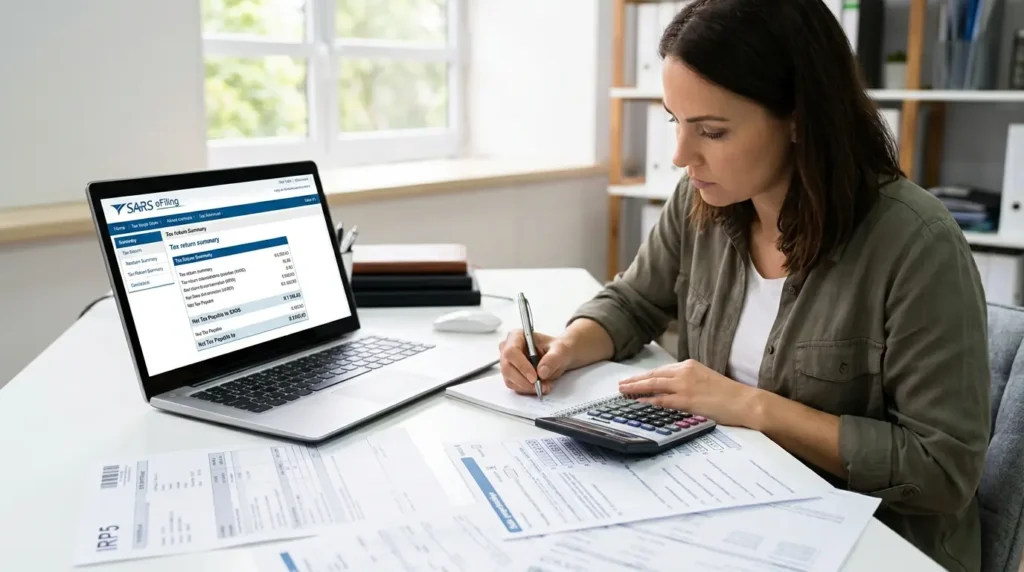
Calculating income tax can seem complicated, especially when you have to consider tax brackets, rebates, deductions, medical expenses, retirement contributions and other sources of income.
The good news is that the basic process is relatively straightforward once you understand the difference between your total income and your taxable income.
Your income tax is generally calculated based on your taxable income for the relevant tax year. This can include your salary, business income, rental income, investment income and other taxable amounts. SARS then applies the relevant tax rates and takes allowable rebates and credits into account to determine how much tax you owe.
This guide explains how to calculate income tax and gives you a simple way to estimate your tax liability.
Who Needs To Pay Income Tax?
You generally need to pay income tax when your income exceeds the applicable tax threshold for your age.
For the 2027 tax year, which runs from 1 March 2026 to 28 February 2027, the thresholds are:
- Under 65: R99,000
- 65 to below 75: R153,250
- 75 and older: R171,300
The threshold is the level of taxable income above which income tax becomes payable.
It is important to understand that not every rand you earn is necessarily taxed at the same rate. South Africa uses a progressive tax system. This means that different portions of your taxable income are taxed at different rates.
For the 2027 tax year, the rates range from 18% to 45%, depending on your taxable income. For example, taxable income up to R245,100 is taxed at 18%, while the portion of taxable income above R1,878,600 falls into the 45% bracket.
Being in a higher tax bracket does not mean that your entire income is taxed at that higher rate. Only the portion falling within that bracket is taxed at the corresponding rate.
PAYE Vs Provisional Tax Payer
One of the first things to establish when working out your income tax is whether you are a PAYE taxpayer or a provisional taxpayer.
PAYE, or Pay As You Earn, generally applies to employees. Your employer deducts employees’ tax from your salary each month and pays it to SARS on your behalf. The amount deducted is calculated using the applicable SARS tax tables.
For example, if you earn a salary from one employer and have PAYE deducted every month, you are normally not required to make separate provisional tax payments simply because you earn a salary.
A provisional taxpayer is generally someone who receives income that is not fully subject to PAYE. This can include self-employed individuals, business owners, freelancers, investors and people earning significant rental or other income outside of their salary.
Provisional taxpayers make payments towards their expected annual tax liability during the tax year. These payments are generally made using an IRP6 return. SARS then takes the provisional tax payments, together with any PAYE already paid, into account when determining the final tax liability.
For example, a self-employed person may estimate their taxable income for the year, calculate the expected tax and make the required provisional tax payments. Their final tax liability is then calculated when they submit their annual income tax return.
How To Calculate Income Tax?
The easiest way to understand how to calculate income tax is to break the process into a few steps.
Step 1: Calculate your total taxable income.
Start with the income you received during the tax year that is taxable. This could include salary, business profits, rental income, interest, certain dividends, commissions and other taxable income.
Step 2: Subtract allowable deductions.
Certain expenses and contributions may be deductible from your income, depending on your circumstances and the relevant tax rules.
This gives you your taxable income.
Step 3: Apply the relevant tax bracket.
For the 2027 tax year, SARS uses the following individual tax rates:
| Taxable Income | Tax Payable |
|---|---|
| R1 – R245,100 | 18% of taxable income |
| R245,101 – R383,100 | R44,118 + 26% above R245,100 |
| R383,101 – R530,200 | R79,998 + 31% above R383,100 |
| R530,201 – R695,800 | R125,599 + 36% above R530,200 |
| R695,801 – R887,000 | R185,215 + 39% above R695,800 |
| R887,001 – R1,878,600 | R259,783 + 41% above R887,000 |
| R1,878,601+ | R666,339 + 45% above R1,878,600 |
These are the SARS individual tax rates for the 2027 tax year.
Step 4: Subtract applicable rebates and tax credits.
Your final tax payable can be reduced by applicable rebates and tax credits, such as the primary rebate and medical scheme fees tax credit.
For a quick estimate, you can also use our free income tax calculator, which is specifically designed to help you calculate your income tax.
Formula in simple terms:
Taxable income → Apply tax rates → Subtract rebates and applicable credits = Estimated tax payable
For a personalised calculation, use the Tax Shop Outeniqua income tax calculator.
What About Income Tax Deductions?
Deductions and tax rebates can make a significant difference to your final tax liability, but they are not all treated in the same way.
For example, contributions to approved pension, provident and retirement annuity funds can qualify for a deduction. For the 2027 tax year, retirement fund contributions are generally deductible at 27.5% of the greater of remuneration or taxable income, subject to an annual limit of R430,000. Certain excess contributions can be carried forward.
Medical expenses work differently. Medical scheme contributions can qualify for a Medical Scheme Fees Tax Credit, rather than simply being deducted from taxable income. For 2027, the monthly credit is R376 for the taxpayer and/or first dependant, with R254 for each additional dependant.
There may also be an additional medical expenses tax credit where you have qualifying medical expenses, subject to the applicable rules and limitations.
Your age also affects your tax calculation because of the applicable rebates. For the 2027 tax year, the primary rebate is R17,820. Taxpayers aged 65 and older receive an additional R9,765 secondary rebate, while those aged 75 and older receive a further R3,249 tertiary rebate.
Travel allowances can also affect your taxable income. If you receive a fixed travel allowance from your employer, generally 80% is included when calculating PAYE, although this can be reduced to 20% where at least 80% of the vehicle’s use is for business purposes. The eventual deduction is determined according to the applicable rules and supporting records, including a logbook.
Other deductions may apply depending on how you earn your income. This is why simply taking your annual salary and multiplying it by a tax percentage will not necessarily give you an accurate result.
How Do I Pay My Income Tax?
How you pay your income tax depends largely on how you earn your income.
If you are a PAYE taxpayer, your employer normally deducts PAYE from your salary every month. Your employer pays this amount to SARS on your behalf. At the end of the tax year, you can submit your annual income tax return using an ITR12 through SARS eFiling.
Your employer should provide you with an IRP5 certificate, which contains details of your remuneration and PAYE deducted during the year. You use this information when completing your tax return.
For example, if R8,000 in PAYE was deducted from your salary throughout the year and your final tax calculation shows that you owed R7,500, the difference may result in a refund, provided there are no other amounts owing to SARS.
If you are a provisional taxpayer, you generally make provisional tax payments during the year using the IRP6 return. These payments are based on an estimate of your taxable income. The provisional payments are then taken into account when your final annual tax liability is calculated.
Your final tax return is generally submitted using the ITR12. SARS has also updated its filing requirements for the 2026 filing season, including additional transactional information that may need to be declared in certain circumstances.
Keeping accurate records throughout the year is therefore important. Your payslips, IRP5, medical tax certificate, retirement annuity certificates, travel records and other supporting documents may all be relevant when completing your return.
Conclusion
Knowing how to calculate income tax can help you understand what you should be paying and identify deductions and rebates that may apply to your circumstances. However, calculating your final tax liability can become more complicated when you have multiple income sources, investments, rental income, business income, travel allowances or other deductions.
Tax Shop Outeniqua can help you with your tax returns and ensure they are completed correctly. Our professional tax consulting services can also help you identify legitimate deductions, rebates and tax planning opportunities so that you pay as little tax as legally possible.
If you are unsure about your tax position or simply want a professional to handle your return, getting advice from a tax professional can help you avoid costly mistakes and ensure that your tax affairs are properly managed.